



.jpg?quality=95)

Cross-docking in the Baltics, the Nordics, Europe and Asia
Why choose cross-docking with us?
By consolidating your flow with one logistics partner located close to your production site, you gain a more efficient process, higher quality, and full control from factory to final customer. We optimise every part of the flow – from consolidation and quality checks to tracking and deviation handling – ensuring a reliable, cost‑efficient and predictable delivery.
How cross-docking works with us?
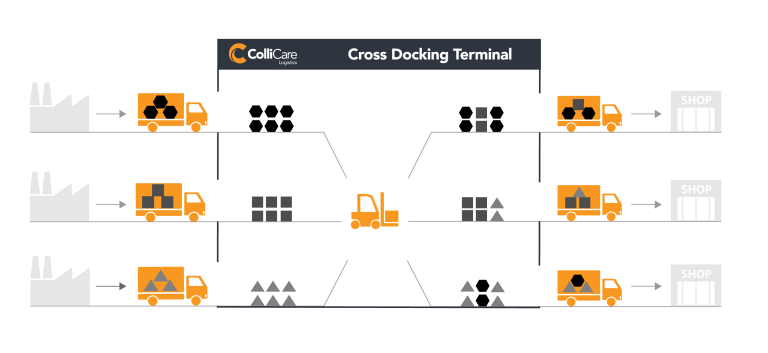
To secure an efficient and predictable flow, we manage the entire process from pickup and consolidation to transport and last mile. Here’s how we work – step by step:
- Pickup from all suppliers
Local teams in Asia and Europe collect goods from your manufacturers. - Consolidation and quality assurance
Scanning, checks, labelling, repacking and other value‑added services. - Cross-docking and preparation
Goods are sorted by destination and prepared for direct distribution. - Transport to Europe and the Nordics
Sea, rail or intermodal – always optimised for cost, time and sustainability. - Last mile and store delivery
Direct to store, warehouse or end customer – with full visibility throughout.
Better quality and fewer errors
- Fewer handling points reduce the risk of damage and delays
- Quality checks and scanning at inbound and outbound
- Dedicated teams in Asia and Europe ensure precision throughout the operation
Full traceability and predictability
- Real‑time track & trace from order to delivery
- Control tower with proactive deviation handling
- EDI integration and order/PO management
- Direct delivery from the cross-docking hub to stores or end receivers ensures predictable lead times
Logistics and value‑added services
- Consolidation, cross-dockingCross docking
A practice in logistics of unloading materials from an incoming semi-trailer truck or railroad car and loading these materials directly into outbound trucks, trailers, or rail cars, with little or no storage in between, labelling, quality checks, and repacking - Customs handling and documentation
- Vendor and supplier coordination
- Local presence in China, India, and Southeast Asia
- Direct distribution setups to Europe and the Nordics

Local presence in Asia
With our own teams in Asia we ensure: better quality, faster handling, and full control throughout the supply chain.
- China
- India
- across Southeast Asia
Local presence in the Baltics and the rest of Europe
We combine our own staff, local expertise, and a broad network of strategic hubs to secure fast, stable, and cost‑efficient deliveries across Europe.
- Rotterdam – main hub for sea and intermodal
- Lübeck/Travemünde – intermodal gateway
- Duisburg – European rail hub
- Jönköping, Vestby, Kløfta, Klaipeda, Gdynia, Parma
- First and last mile transport across the Nordics
Client testimonials

“ColliCare consolidates our volumes from Lithuania to all our shops in Sweden.”

“Clear, specific, and timely information, along with open communication, are the most important qualities of ColliCare for us.”

Cross-docking services
To secure an efficient and quality‑assured flow, we offer a wide range of services supporting the entire process – from pickup and consolidation to preparation, documentation and distribution.
- Consolidation and cross-docking
- Quality control
- Inbound/outbound scanning – full traceability
- Labelling and preparation for distribution
- Customs handling and documentation

Solveiga Seredė
Managing Director LithuaniaFAQ – cross-docking, flow and digital tools
Cross-docking is a logistics method where goods are transferred directly from inbound to outbound transport without storage. It is especially beneficial when you have many suppliers, short lead times or want lower costs and fewer errors.
Cross-docking is a logistics process where goods are transferred directly from inbound transport to outbound delivery with little or no storage time. Warehousing involves storing goods in a facility until they are needed for distribution.
Cross-docking focuses on speed and flow, while warehousing focuses on inventory storage and availability.
- We collect goods from various suppliers and manufacturers and transport them to our terminal.
- At the terminal, goods are grouped, consolidated, and prepared for direct delivery to individual stores across Europe.
- Items are scanned so that clients can track and see the exact location of their goods.
- Shipments are transported by sea to a port as close as possible to the recipient or delivered by road to the specified destination.
We do everything to minimise handling, while our professional staff oversee the entire process, reducing the risk of errors.
Yes, the movement of every shipment across the Baltic States, Scandinavia, other European countries, and Asia can be monitored in real time. In our online logistics management system, eCare, you can access full shipment reports and manage your logistics from order to delivery in the way that suits you best.
Through scanning, quality checks, control tower monitoring, eCare and EDI integration – ensuring full visibility from order to delivery.
The advantages of cross-docking include:
- Lower transport costs thanks to optimised freight flows.
- Faster delivery to the end recipient.
- A more sustainable and environmentally friendly logistics process due to fewer transhipments and additional transport operations.
- Control and transparency – shipments are tracked in real time, and reports are provided.
Didn't find what you were looking for?

